
THE SCIENCE BEHIND SPECIALITY CHEESE
INTRODUCTION TO DYNAMIKO'S FONTINA CHEESE CULTURE MIXhttps://dynamikoingredients.zohocommerce.com/products/c22e35334d/4122928000012445005
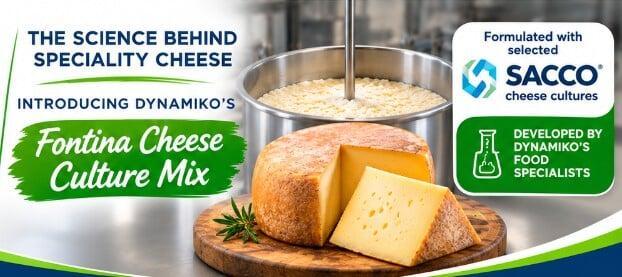
Behind every speciality cheese is a carefully controlled manufacturing process, where the selection of suitable cultures plays an important role in developing the finished product's flavour, texture and overall characteristics. Cheese cultures are microorganisms used to initiate and control fermentation. They contribute to the development of acidity, influence the cheese-making process and help establish the flavour and texture characteristics associated with different cheese varieties.
For cheesemakers looking to expand their speciality cheese range, selecting the right combination of cultures is an important consideration.
Introducing Dynamiko's Fontina Cheese Culture Mix – a specialist blend formulated using selected SACCO cheese cultures and developed by Dynamiko's food specialists. Combining selected cultures with formulation expertise, this blend offers a convenient solution for manufacturers interested in producing Fontina-style cheese.
Let's explore the science behind cheese cultures and the role each culture plays in this specialist blend.
1. Understanding the importance of cheese cultures
Cheese cultures are selected microorganisms, primarily lactic acid bacteria, used in cheese manufacturing to initiate fermentation.
Their primary function is to convert lactose (milk sugar) into lactic acid.
This acidification process is essential because it influences several important stages of cheese production:
Acid development: Reduces the pH of milk and curd during fermentation.
Curd formation: Influences the coagulation process and the structure of the developing curd.
Moisture control: Helps influence whey expulsion and moisture retention.
Texture development: Contributes to the final body and consistency of the cheese.
Flavour development: Selected cultures produce enzymes and metabolic compounds that contribute to the cheese's flavour and aroma.
Maturation: Culture-related enzymatic activity contributes to biochemical changes during cheese ripening.
Different cheese varieties require different culture combinations, depending on the desired flavour, texture, moisture and manufacturing process.
2. Understanding Dynamiko's Fontina Cheese Culture Mix
Dynamiko's Fontina Cheese Culture Mix is a specialist formulation developed using three selected SACCO cheese cultures.
Each culture has a particular role in the overall fermentation and flavour-development system.
- Lyofast ST REGINA S: A thermophilic culture containing Streptococcus thermophilus, supporting primary acidification and controlled fermentation during cheese production.
- Lyofast LH 13: An adjunct culture containing Lactobacillus helveticus, contributing proteolytic activity and flavour development during cheese maturation.
- Lyofast MW 035 TA: A mixed mesophilic culture that supports fermentation and contributes to the development of characteristic aromatic and buttery flavour notes.
The above functional descriptions should be checked against the current SACCO technical data sheets before being used as definitive strain-specific claims.
3. How do the three cultures complement one another?
The formulation brings together different culture functions to support the development of Fontina-style cheese.
- Primary acidification: The thermophilic culture contributes to lactose fermentation and acid development. Controlled acidification is important for curd formation, whey separation and the development of the desired cheese structure.
- Proteolytic activity and flavour development: Selected adjunct cultures contribute enzymatic activity that helps break down proteins during maturation. This process releases peptides and amino acids, which contribute to the development of the cheese's flavour profile.
- Aromatic development: Mesophilic cultures can contribute additional metabolic activities, including citrate utilisation, which may support the development of buttery and aromatic flavour compounds.
The combined culture system is intended to support a balanced fermentation and flavour-development process.
The final characteristics will depend on culture dosage, milk composition, processing conditions and maturation management.
4. Understanding the Fontina-style cheese manufacturing process
The following outlines a general process. Exact temperatures, culture dosage, pH targets and processing times must be established using the approved formulation and production trials.
- Step 1: Milk preparation - Select good-quality milk suitable for cheese production. Milk composition, microbiological quality and acidity should be assessed before processing.
- Step 2: Culture inoculation - Add the selected cheese culture blend according to the recommended dosage and inoculation procedure.
- Step 3: Fermentation - Allow the cultures to develop under controlled conditions. Monitor acidification and pH development to ensure that fermentation progresses appropriately.
- Step 4: Coagulation - Add suitable rennet to coagulate the milk and form a firm curd.
- Step 5: Curd cutting - Cut the curd to the required size to encourage whey separation and establish the desired moisture content.
- Step 6: Curd cooking - Apply controlled heating and agitation according to the intended cheese style. This stage influences curd firmness and moisture retention.
- Step 7: Whey drainage - Separate the whey from the curd while maintaining appropriate handling and process conditions.
- Step 8: Moulding and pressing - Transfer the curd into suitable moulds and apply controlled pressing to achieve the desired shape, structure and whey expulsion.
- Step 9: Salting - Apply an appropriate salting method to develop flavour and assist in moisture management and rind formation.
- Step 10: Maturation - Allow the cheese to mature under controlled temperature and humidity conditions. During this stage, flavour, aroma and texture continue to develop.
5. Factors influencing the quality of speciality cheese
Even with carefully selected cultures, several manufacturing factors influence the final cheese quality.
Factor | Importance |
|---|---|
Milk quality | Influences composition, fermentation and final cheese characteristics |
Culture dosage | Determines the inoculation level and influences fermentation performance |
Temperature | Influences culture activity and acidification rate |
pH development | Affects curd structure, moisture and texture |
Coagulation | Influences curd strength and whey separation |
Moisture | Affects consistency, maturation and shelf-life |
Salt | Contributes to flavour, moisture management and microbial control |
Maturation | Influences flavour, aroma and texture development |
Monitoring these parameters helps cheesemakers achieve greater control and consistency during production.
6. Common challenges in cheese manufacturing
Cheesemaking involves several variables, and inconsistencies can affect the finished product.
Some common challenges include:
- Slow acidification: May be associated with incorrect culture dosage, unsuitable temperatures, milk composition or bacteriophage activity.
- Excessive moisture: Can influence cheese texture, maturation and storage stability.
- Poor curd formation: May result from unsuitable milk conditions, incorrect coagulation parameters or processing errors.
- Inconsistent flavour: Can be influenced by culture performance, fermentation conditions, salt levels and maturation management.
- Texture defects: May be associated with moisture imbalance, pH development, curd handling or pressing conditions.
Careful process monitoring and appropriate technical guidance are important when troubleshooting these issues.
7. Storage and handling of cheese cultures
Freeze-dried cultures require careful handling to maintain their activity.
General handling considerations include:
Store cultures at - 18ºC (or below) in a freezer.
Maintain an uninterrupted cold chain.
Keep packaging securely sealed until use.
Protect cultures from moisture and contamination.
Avoid unnecessary temperature fluctuations.
Follow the manufacturer's instructions for opened packs and unused material.
Observe the stated expiry date and batch identification.
8. Why choose Dynamiko's Fontina Cheese Culture Mix?
What makes the blend distinctive?
Formulated using selected SACCO cheese cultures.
Combines different culture functions within one specialist blend.
Developed by Dynamiko's food specialists.
Designed for Fontina-style cheese manufacturing.
Offers an opportunity to expand speciality cheese production capabilities.
9. Take your speciality cheese production further
Speciality cheese manufacturing requires the right combination of ingredients, cultures and processing expertise. Whether you are developing a new cheese variety or expanding an existing product range, understanding the role of cultures is an important step towards achieving the desired product characteristics.
Dynamiko's Fontina Cheese Culture Mix brings together selected SACCO cultures in a specialist formulation developed by our food specialists.
Looking to explore Fontina-style cheese production? Contact Dynamiko Food Ingredients for product information, culture specifications and technical assistance.
Dynamiko Food Ingredients
Specialist ingredients. Expert formulations. Endless possibilities.