
HOW CHÉVRE IS MADE - THE ART & SCIENCE OF LACTIC CHEESEhttps://dynamikoingredients.zohocommerce.com/products/h7403ebcb6/4122928000160797066
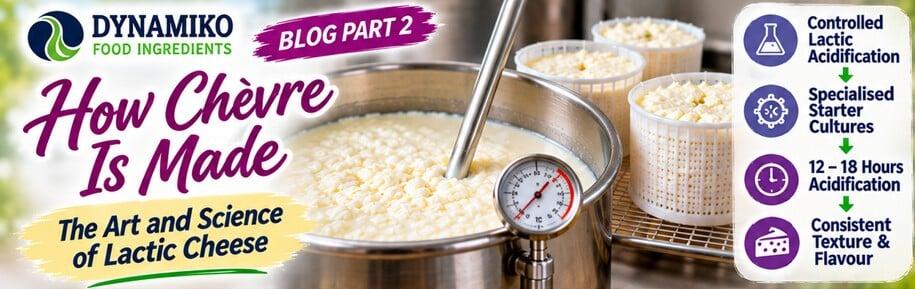
Making excellent Chèvre is both simple and precise. Success depends on milk quality, temperature control, and — most importantly — the right starter culture.
Typical production steps:
Milk preparation
Fresh goat’s milk (raw or pasteurised) is gently warmed to 20–32 °C.Inoculation
A carefully selected lactic culture is added. For consistent, high-quality results, a balanced blend such as the Chèvre Cheese Culture Mix (Lyofast MOS 062 C + Lyofast MW 035 TA) is ideal.- MOS 062 C delivers reliable acidification and clean flavour.
- MW 035 TA contributes mild buttery notes through citrate fermentation and helps create a lighter, more appealing texture.
Coagulation
The milk is left undisturbed for 12–18 hours. The culture slowly lowers the pH, forming a soft lactic curd.Draining
The curd is ladled into moulds or drained in cloth. Draining time determines the final texture — shorter for a moist, spreadable cheese; longer for a drier, more crumbly style.Salting and finishing
Salt is added, and the cheese may be left plain or coated with herbs, ash, spices, or honey.
The choice of culture is critical. A well-designed mix ensures uniform acidification, controlled flavour development, and consistent texture from batch to batch — whether you are a small farmstead producer or a larger dairy.